
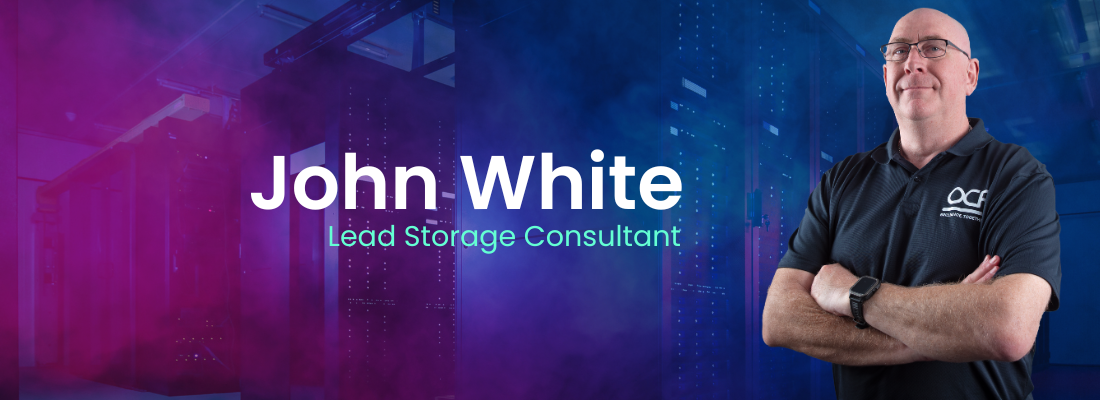
When I look back over my 30+ years in the IT industry, one thing stands out clearly: my career has never been defined by job titles. Instead, it’s been shaped by the diverse roles I’ve taken on, the technologies I’ve explored, and the constant drive to understand systems from the inside out.
Over the years, I’ve had the opportunity to work with a wide range of storage solutions and hardware vendors. Each environment brought new challenges, new architectures to learn, and new ways to solve problems. It wasn’t until the last 15 years that my path began to narrow, homing in on something that would become both my professional focus and passion: HPC storage.
That shift solidified when I joined the team at OCF Ltd. Becoming part of the OCF family opened the door to a deeper world of High-Performance Computing, where storage is not just a component but a critical enabler of scientific breakthroughs and complex workloads. Since then, I’ve continued to grow, eventually stepping into my current role as Lead Storage Consultant.
-------------
Information has always been the driving force behind business. From the early days of commerce to today’s data-driven enterprises, information determines success. Yet for years, the spotlight has been on the hardware; the “shiny boxes” that process data, rather than on where and how that data is stored.
That’s changing. The “where” and “how” of data storage are now just as important as the “what.” Whether for AI or traditional workloads, organisations are realising that data is their most valuable commodity and protecting it is paramount.
High-Performance Computing (HPC) environments handle massive volumes of sensitive data, making security a real challenge, especially when performance and accessibility can’t be compromised.
Modern storage solutions can encrypt data in-flight or at rest, often using self-encrypting drives (SEDs) or external key managers. Tiered storage also helps by encrypting only the data meant for long-term retention.
However, encryption alone isn’t a silver bullet. It protects against disk failures and unauthorised access, but ransomware and data theft can still strike if overall system security is breached. That’s why secure access controls and a robust backup strategy including offline copies are critical defences in any HPC environment.
There’s no escaping it: AI is reshaping the HPC landscape.
For years, HPC has pushed the limits of I/O performance, but AI has accelerated that evolution. We’re now seeing networking speeds of 800Gb/s, double what was common just two years ago.
In traditional HPC clusters, it’s common to see two to four tiers of storage:
AI workloads, however, demand even faster performance. This has led to the addition of a fifth tier, NVMe storage, sitting in front of SSDs for ultra-low latency data access.
As data volumes explode, storage capacity needs have skyrocketed. Larger SSDs and HDDs are being deployed in high-density enclosures, some housing over 100 disks in a single unit.
This introduces new challenges around weight, power, cooling, and rack depth. At the same time, traditional RAID configurations are struggling to keep up with rebuild times on today’s massive drives. Many systems are now shifting toward disk pools with distributed parity and spares, offering better resilience and performance.
Modern workloads, especially those involving AI handle structured, unstructured, and semi-structured data. As a result, storage systems are evolving to support hybrid access models (file, object, and block) and to tier data seamlessly between on-premises and cloud environments.
Choosing the right solution has become more complex. The long-standing leaders of Lustre and IBM Storage Scale (GPFS) still dominate, but innovative newcomers like BeeGFS, WEKA, and VAST are shaking up the field with fresh ideas and technologies.
As HPC environments grow, managing and understanding data becomes more challenging. Tools like Starfish and RobinHood, along with built-in or add-on analytics from IBM, DDN, and BeeGFS, help administrators visualise, track, and optimise data usage.
Storage is also becoming smarter. New features such as GPUDirect RDMA, IBM’s Content-Aware, and DDN’s Hot Pools are designed to streamline AI pipelines. In fact, AI is helping AI, with AI itself now being used to predict and prefetch its data.
This is just the beginning. Emerging technologies like computational storage and CXL memory promise to further revolutionise how data is managed and moved. HPC storage isn’t just getting bigger and faster it’s becoming intelligent.
At OCF Ltd, we combine experience and innovation to help organisations navigate this evolving landscape from storage and compute to AI and cloud solutions.
As AI continues to reshape the world of HPC, one thing is clear: the future belongs to those who can harness, protect, and intelligently use their data.